 Made in Denmark
Latest News
Modular PVD cluster systems: Building with the Flextura platform
Celebrating 10 years anniversary for the Flextura PVD platform, we summarize the most important development steps for this platform.
Development Step: Modularity
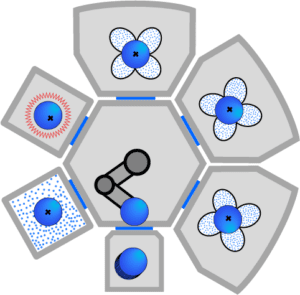
From the very beginning, one idea has been at the heart of the Flextura® PVD platform: the system should be able to grow with future needs.
Every Flextura process module, whether a sputtering module, an evaporation module, a GLAD module, or an etch and degas station, is designed to work in multiple configurations.
- Start with a single substrate load lock for focused, standalone research.
- Step up to cassette loading when throughput demands increase.
- Connect the same module to a fully automated cassette-to-cassette cluster when your facility is ready for volume production or your product needs multiple process steps without vacuum breaks.
The module itself is the same. Only the system around it grows.
As Christian Kjelde, Sales Manager at Polyteknik, reflects; “designing the Flextura PVD platform from scratch, meant modularity could be made a core priority. One of the greatest long-term benefits for customers”.
Scale up, without starting over
A researcher might begin with a single Flextura Sputter module and a load lock – a compact, high-quality tool that fits in a small cleanroom and delivers serious thin film results from day one.
Years later, as the development matures and production demands follow, that same core module can be plugged directly onto a Flextura Cluster platform, joined by an evaporation module, a high-temperature deposition chamber (up to 1000°C), or in-system analytical module – all without discarding the original investment.
The Flextura 200 Cluster illustrates this thinking at its most complete. A 200mm platform that is truly almost plug-and-play, allowing process modules to be added as the need for capacity or new processes increases. A proven Brooks MAG LEAP robot handles wafer transport between modules, while the platform accommodates everything from standard SEMI cassettes to custom carriers for even greater flexibility.
For research environments, the Flextura R&D Cluster takes the concept further still. It unveils a new way of modular thinking for PVD systems. From a single chamber with evaporation or sputtering as a standalone system, to an efficient research and development cluster tool with multiple advanced processes. Analytical modules can be attached to the cluster, enabling in-situ characterisation without ever breaking vacuum.
All process modules can be integrated into the Flextura Cluster platform or delivered as standalone tools, with single-substrate, cassette, or batch load-lock configurations.
The Flextura way of thinking lets capital investment follow the increasing demands of a facility.

Polyteknik AS
Moellegade 21
DK-9750 Oestervraa
Denmark
CVR.: 26672031
E: sales@polyteknik.dk
P: +45 9689 2800
PVD Systems
Coating Service
Information


